
Understanding Asuquo's Law of Composition of Resultant Force
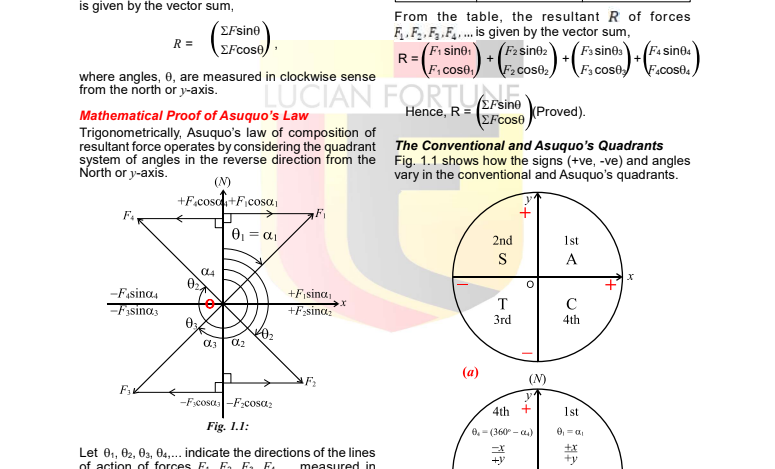
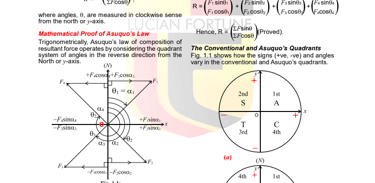
The Law is very useful to users such as physics students, physics/mathematics teachers, scientists, physicists, mathematicians, engineers and other mathematically inclined professionals whose fields are related to VECTORS and MECHANICS .
The applications of this law have been demonstrated in series of constructed questions and their solutions provided below. Find out more >>>
Introduction to Asuquo's Law
Physics and mathematics have always coexisted, providing a robust framework for understanding the natural world. The recent discovery and development of Asuquo's Law of Composition of Resultant Force by the Nigerian scientist Uwem E. Asuquo marks a significant contribution to this field. This law articulates how resultant force can be calculated when two or more coplanar non-parallel forces act at a point, enhancing our grasp of vector calculations in physics and mathematics. Read more >>>
The Mathematical Representation
Asuquo's law can be represented by the vector model, R= (Σf sin θ) / (Σf cos θ). where, R denotes the resultant force; ΣFsinθ denotes the sum of the horizontal (x) components of the forces; ΣFcosθ denotes the sum of the vertical (y) components of the forces; North angles θ indicate the directions of the line of action of the forces, measured in clockwise sense from the North or y-axis. This formula provides a streamlined method for calculating the resultant of multiple forces acting on a particle, emphasizing the significance of vector components in effective force analysis. View Asuquo's Law >>>
Understanding the Implications
The implications of Asuquo's Law extend beyond theoretical mathematics into practical applications in engineering and physics. For instance, in system where multiple non-parallel forces act, understanding the resultant vector is crucial for ensuring stability and balance within structures. This law enhances existing physics theories by providing a clear method of determining the resultant force in internetworking systems of forces, which can be critical in various engineering tasks. View Asuquo's Law >>>
The Journey to Discovery
Uwem E. Asuquo made this groundbreaking discovery during laboratory research aimed at exploring classical mechanics principles. His rigorous experiments enabled him to derive this law, which encapsulates the essence of vector addition in a very direct manner. The contributions made by Uwem E. Asuquo serve as a reminder of the rich potential that dedicated scientific inquiry holds, especially in fields like mathematics and physics where discoveries often lead to profound advancements. View Asuquo's Law >>>
Conclusion
Asuquo's Law of Composition of Resultant Force not only simplifies the understanding of how forces interact but also enriches the existing body of work in physics and mathematics. The ability to calculate the resultant force using a straightforward formula empowers scientists and engineers alike, providing a tool to address complex systems. His work will undoubtedly inspire future research and experimentation, paving the way for new innovations in scientific disciplines.
+2348117141583
Lucian Fortune © 2026. All rights reserved.
lucianfortune18@gmail.com
Information
Quick Links
Partner With Us
26, Magboro- Makogi Road, Obafemi Owode, 110115, Ogun State
Lucian Fortune Media
Lucian Fortune Farms
Invest In Lucian Fortune
Refer Lucian Fortune
Support Lucian Fortune
For Updates
Ibafo Market, By Oba Palace, In Front Of Admor Link Phone Store, Ibafo, Obafemi Owode, 110115, Ogun State